Monday, August 13, 2012

App.net hits $500,000 target: now can it rival Twitter with a paid-for service?


Dalton Caldwell reckons that people will pay for an ad-free real-time social networking service - and now has half a million dollars'funds to prove it, from around 10,000 users. Next: winning in the attention economy
Twitter
Twitter on a smartphone. Time is the one resource that's shared out equally - so companies compete for it fiercely. Photograph: Jonathan Hordle/Rex Features
Would you pay to use Twitter? A service called App.net has just indicated that at least some people would, by hitting a target of raising $500,000 in funding from individuals paying $50, $100 or $1000 to set up a Twitter clone where "users and developers come first, not advertisers".
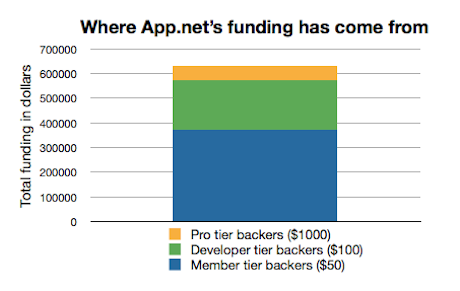
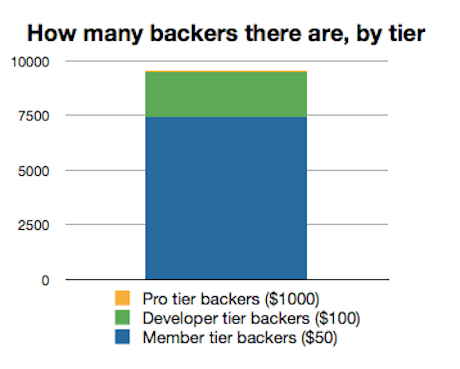
The brainchild of Dalton Caldwell, a San Francisco-based developer who was one of the people behind the "web 2.0" resurgence in 2006, the scheme hit its target funding on Sunday evening more than a day ahead of its deadline. At the time of writing 7,448 people are offering to pay the base $50 level for access to post to the service, 2,010 paying $100 to be developers with access to back-end functionality, and 59 paying $1,000 for "pro tier" access including phone support and a personal meeting with Caldwell. (See the graph of funding sources.)
App.net funding sourcesWhere App.net's funding has come from, by tier (member, developer and "pro")App.net members by tierApp.net members, by tier
Caldwell began building the service because he, along with a number of other developers, had become uneasy about Twitter's approach to developers building third-party applications, where it has blocked a number of sites and services from accessing its API, the "hook" that external software needs to provide Twitter functionality. As Twitter tries to generate revenues from its fast-growing user base, it has been putting more restrictions on what developers can do - leading to restlessness among those who have built apps for it.
"We believe that advertising-supported social services are so consistently and inextricably at odds with the interests of users and developers that something must be done," Caldwell wrote on the App.net signup page.
Speaking to Technology Review, he said that "Twitter created as fundamental a technical innovation as e-mail and HTML itself, and they totally blew it." Twitter has been tightening access to its API and the extent to which developers can use it progressively since 2010.
The most audacious aspect of the project is that unlike almost every other service coming out of San Francisco - and in stark contrast to Twitter, which is and has been free to post and develop for - App.net charges its users.
In a blog post in July, Caldwell says that the key problem with Facebook and Twitter, which offer an ad-supported platform, is that "this 'platform" word starts to get very troubling when talking about business models. Building on top of a platform is a foundational risk, and if your platform decided one day that it doesn't like what you are doing, or likes what you are doing so much they want to compete with you, it's Very Bad. Your platform partner can easily damage your quality of service, or simply shut you down. If that happens, your business is dead."
Caldwell argues that if users and developers are paying to use the service, then the operator has no incentive to shortchange either - and no incentive either to intrude into eithers' experience by inserting adverts into feeds (as both Facebook and Twitter do).
There are relatively few examples of paid-for alternatives to free services which offer essentially the same functionality as the free version. One isPinboard, a paid-for bookmarking service that offers the same functionality as the free Delicious. While Delicious is free to use, on Pinboard each user pays a one-off fee on joining for lifetime use; the fee rises with the number of users. (Guardian Technology has been a paid-up user of Pinboard since mid-2011.)
In general, though, paid services struggle to grow as quickly or as large as free ad-supported services because users are reluctant to provide upfront payment to a service that may fail, and where its value to them may be different from that being charged, because peoples' earning power varies widely.
By contrast ad-supported services in effect charge people for their attention to adverts - and everyone has 24 hours in a day, so in effect everyone pays the same attention cost (though perhaps not potential earnings cost) for an advert.
Some services then offer "premium" services by exploiting peoples' ability to pay not to have their attention diverted by ads, or for extra functionality - creating "freemium" services with different tiers of users.
Caldwell though aims to buck the trend for services to try to grow entirely on ad-supported models. The idea of app.net grew from a blogpost on 13 July, in which he announced an "audacious proposal". In it, he pointed to the problems he perceived with SourceForge, an ad-supported code repository: "the site was designed to squeeze every lasat advertising penny out of you," Caldwell wrote. By contrast, he pointed to Github, a freemium service which offers some facilities for free and charges for others.
"Contemplate for a moment how scary a theoretical purely ad-supported Dropbox would be," he noted, referring to the cloud-based freemium storage service which offers a shareable file locker service. "I can easily imagine the overly-cheerful corporate blogpost explaining why placing ads in my personal documents, or selling the file-listing of my music collection to the music industry, or shutting down IFTTT [If This Then That, a service that allows automation of web services] API access is 'important to the health and welfare of the community.' I happily pay to avoid that nightmare scenario, wouldn't you?"
At its core, Caldwell's proposal - and its success so far, attracting just under 10,000 paying customers - points to a rumble of dissatisfaction within some parts of American culture with the pervasive nature of advertising there. "Why isn't there an opportunity to pay money to get an ad-free feed from a company where the product is something you pay for, not, well, you?" Caldwell asks.
He points to Imeem - a social media sharing company he founded and ran - which, despite raising more than $50m in venture capital and selling more than $2m of advertising per month at its peak, was sold to MySpace in 2009.
Instead, he revealed, he has been focussing on a service called App.net, "a paid service for mobile application developers", with a consumer-focussed iOS app and service.
Caldwell thinks that the 10,000 figure for paying backers is sufficiently large to mark a critical mass - as long as the backers are the right people. Paul Graham, a venture capitalist with long experience in the software industry, suggests that "a search engine whose users consisted of the top 10,000 hackers and no one else would be in a very powerful position despite its small size".
Certainly App.net has garnered a number of high-profile names, including Stephen Fry and many of the people who were early adopters of Twitter.
What is less easy to know is how App.net will fare in what will become a war for time and attention with bigger, established sites and services. Facebook has 955 million users; Twitter, more than 100 million. Will 10,000 be enough to start changing that?

Friday, July 27, 2012

Microsoft Admits Surface Tablet Might Alienate Partners


Microsoft Surface Tablet
Microsoft this week admitted that its upcoming Surface tablet might hurt its relationships with PC maker partners.
As first noted by the New York Times, Redmond said in a Thursday filing with the Securities and Exchange Commission (SEC) that "our Surface devices will compete with products made by our OEM partners, which may affect their commitment to our platform."
Microsoft unveiled the Surface tablet in late June during a secretive, last-minute Los Angeles press conference. At the time, a major question was whether Microsoft's usual partners, who had all pledged to develop Windows 8 tablets and PCs, had any idea that the Surface was in the pipeline. According to a report from Reuters, Redmond only gave companies like Acer, Asus, Dell, and others a three-day heads up before taking the wraps off its Surface tablet.
A week later, Hewlett-Packard tabled plans for a consumer-targeted Windows RT tablet powered by a Qualcomm-designed ARM processor and instead said it would focus on a business slate using the x86-optimized version of Windows 8, though it did not specifically cite the Surface as the reason for the switch.
Other partners have been largely mum on the Surface, though Acer founder Stan Shih told Digitimes that Surface is simply a way to boost adoption of Windows 8 and will disappear after the first iteration. RIM said that Microsoft's Surface tablet won't change its strategy.
Microsoft's Steve Ballmer said recently that he expects to sell a "few million" Surfaces.
In its filing, Microsoft noted the increasing pressure that tablets and smartphones have placed on the PC market.
"The proliferation of alternative devices and form factors, in particular mobile devices such as smartphones and tablet computers, creates challenges from competing software platforms," Microsoft wrote. "These devices compete on multiple bases including price and the perceived utility of the device and its platform. Users may increasingly turn to these devices to perform functions that would have been performed by personal computers in the past."
As a result, it might be difficult to attract app developers to the Windows platform, Microsoft said.
A dubious $1,000 online listing aside, Microsoft has not yet revealed pricing for the Surface tablet. The device will be released after Windows 8 becomes generally available on Oct. 26.
For more, see PCMag's Hands On With Microsoft's Surface Tablet and the slideshow below. Also check out Microsoft Skims the Surface.
For more from Chloe, follow her on Twitter @ChloeAlbanesius.

For the top stories in tech, follow us on Twitter at @PCMag.

Monday, July 16, 2012

Yahoo gets new CEO: Well-respected Google exec Marissa Mayer


  • Marissa Mayer speaks onstage at the FORTUNE Most Powerful Women Dinner New York City at Hudson Room at the Time Warner Center on May 24, 2011 in New York City.
    Jemal Countess, Getty Images for Time Inc.
    Marissa Mayer speaks onstage at the FORTUNE Most Powerful Women Dinner New York City at Hudson Room at the Time Warner Center on May 24, 2011 in New York City.
Jemal Countess, Getty Images for Time Inc.
Marissa Mayer speaks onstage at the FORTUNE Most Powerful Women Dinner New York City at Hudson Room at the Time Warner Center on May 24, 2011 in New York City.

Sponsored Links

SAN FRANCISCO — Longtime Google executive Marissa Mayer— one of Silicon Valley's best-known personalities — starts work today as Yahoo CEO, becoming one of the most prominent female leaders in business.
The struggling Internet giant announced Monday that it is turning to Mayer, 37 — its fifth CEO in five years — to spearhead a massive turnaround effort that has gained little traction the past few years.
Mayer succeeds interim CEO Ross Levinsohn, who took over for the ousted Scott Thompson, who was shown the door on Mother's Day following résumé inaccuracies. Thompson took over for Carol Bartz earlier this year, after she was shown the door.
At Google, Mayer earned kudos for her management of several key technologies and a reputation as a demanding perfectionist. She molded the look and feel of some of the company's best known, and used, products — services such as Google's search, Gmail and Google News.
The appointment of Mayer, employee No. 20 at Google and one of its few public faces, could perk up spirits among Yahoo employees and investors. Industry analysts such as Jonathan Yarmis called it a PR master stroke for Yahoo, which has struggled mightily to attract, and keep, top-flight talent in its competitive battle with Google and Facebook.
"I'm surprised and impressed," says Yarmis, an analyst at HfS Research who thinks Mayer's hiring could aid in recruiting efforts. "Yahoo has been able to attract someone of the highest caliber here, someone who understands the business. This is really the first thing out of Yahoo in a decade that you can't snicker at. She's the kind of person you didn't think Yahoo could get."
Wall Street applauded the news, lifting Yahoo shares 2% to $15.98 in after-hours trading.
"I am honored and delighted to lead Yahoo, one of the Internet's premier destinations for more than 700 million users," Mayer said in a statement.
Mayer, Google's first female engineer, joins a short list of female tech CEOs at large public companies. The elite club includes Hewlett-Packard CEO Meg Whitman and IBM CEO Virginia Rometty. Sheryl Sandberg, Facebook's chief operating officer, essentially runs day-to-day operations.
"I am personally very excited to see another woman become CEO of a technologycompany," Google Executive Chairman Eric Schmidt said in a statement.
During her 13 years at Google, Mayer was responsible for shaping Google's most popular products — ranging from its search homepage to Gmail and Google Images. Recently, she oversaw the company's location and local services, including Google Maps, encompassing more than 1,000 product managers.
Mayer also sat on Google's operating committee that advised Google co-founders Larry Page and Sergey Brin.
Google CEO Page, in a statement, called Mayer "a tireless champion of our users."
As an early Google employee, Mayer was also something of a celebrity in Silicon Valley. She often spoke at high-profile tech conferences, posed in fashion spreads, including Vogue, was frequently reported in local high-society columns and lived in a posh penthouse in San Francisco's Four Seasons. She's also a connoisseur of cupcakes.
Still, the move to Yahoo is an opportunity for Mayer to claim a bigger stage.
"This is a Hail Mary pass," says Peter Shankman, an independent marketing strategist based in NYC. "If this one doesn't do it, the clock has pretty much ticked out."
A ticklish to-do list
Questions remain whether Mayer can make a difference at Yahoo. Some openly wonder if Mayer's appointment will make a dent. And whether Yahoo might besmirch her stellar reputation if things don't work out.
"She's not at Google anymore, and if she's going to try and out-Google Google, that would be a terrible mistake," analyst Yarmis says. "Clearly, she saw that her path to the top at Google wasn't going well, and revenge can be a powerful, and dangerous, motive."
Mayer's appointment brings a person with cachet and connections to Yahoo, analysts say. But Yahoo has defined itself as a media company working to attract advertising dollars, an agenda echoed by former interim CEO Levinsohn. Mayer's Google tenure and engineering background could signal an about-face for Yahoo.
"She's an engineering type, which in some ways is good news. Ross Levinsohn had said they would focus as a media company, and that was not necessarily good news," says IDC analyst Karsten Weide.
Yahoo's advertising sales business needs to change to shore up its shortcomings, he says. "The future of display advertising will be sold automatically, algorithmically."
The situation isn't entirely dire. The portal attracts about 700 million visitors a month, which helped it generate nearly $1 billion in ad sales last quarter.
But that business is under siege from Google, Facebook and an armada of start-ups vying for eyeballs and revenue. Yahoo's slice of the nearly $40 billion U.S. online ad market — 16% in 2009 — was 9.5% in 2011 and could slide to 7.4% this year, according to eMarketer.
Whether the new CEO and a new board are the fix remains an open question. Analysts will be closely watching Third Point CEO Daniel Loeb, whose hedge fund owns 5.8% of Yahoo and has won three board seats. A hedge fund's influence "runs the risk of making decisions that are good for the short term but not for the long term," Morningstar analyst Rick Summer says.
The January hiring of Thompson, the highly successful CEO of eBay's PayPal unit, was Yahoo's latest stab at a turnaround.
Thompson's hasty exit in May complicated a restructuring plan he put into place that included 2,000 layoffs. It was the latest in a series of missteps the past few years highlighted by multiple CEOs, executive defections, a patent dispute with Facebook, reorganizations and questions about deals with tech partners Microsoft and Alibaba.
For Mayer, it all adds up to inheriting a wayward ship with an uncertain future.

Monday, July 2, 2012

Microsoft, Motorola patent battle hits 9th Circuit; Xbox's future could hinge on the case


Legal wrangling stems from disagreement over Motorola royalties for patened video-compression, WiFi technologies

he closely-watched, two-year international patent dispute in which Motorola Mobility threatens Microsoft's (Nasdaq: MSFT) Xbox and the software giant's place in the German IT marketplace will be likely adjudicated, at least in part, by the U.S. Court of Appeals for the Ninth Circuit.
Microsoft last week asked the San Francisco-based appeals court to affirm a lower court ruling that blocks Motorola Mobility from enforcing a German court's import ban on Microsoft products determined to violate Motorola technology patents.
In its June 27 appellee brief to the Ninth Circuit, Microsoft argued that a U.S. district court judge in Seattle correctly hamstrung Motorola with an injunction, preventing the company from enforcing a German court's trade-ban affecting the Windows 7 operating system and Xbox video-game console, among other Microsoft products.

Sign up for our FREE newsletter for more news like this sent to your inbox!"The district court properly preserved its jurisdiction to interpret and apply Motorola's worldwide license commitments, as squarely presented by Microsoft's complaint," Microsoft counsel Carter Phillips, partner at Sidley Austin LLP, wrote in the company's brief.
Meanwhile, Motorola says on appeal it will argue against the trial court's order. On the Ninth Circuit's Mediation Questionnaire filed May 4, Motorola attorney Kathleen Sullivan wrote that Motorola's principle argument for tossing the injunction is that Motorola fairly won the German judgment.
"The district court erred as a matter of law in entering this anti-suit injunction and that the injunction poses undue affront to comity and proper respect for the distinct sovereign function of the German court," wrote Sullivan, former dean of Stanford Law School and now partner at Quinn Emanuel.
Motorola, she added, asked the Ninth Circuit to hear the appeal "expeditiously," so "at the earliest opportunity," the company can enforce the Mannheim Regional Court judgment against certain Microsoft imports.
The legal wrangling between Microsoft and Motorola--now a Google (Nasdaq: GOOG) company--stems from disagreement over what constitutes reasonable royalty on the sales of Microsoft products that use Motorola's patented WiFi and video technologies.
Microsoft asserts it's entitled to a reasonable, worldwide licensing agreement to Motorola's standard-essential patents. The Redmond, Wash.-based company has sought to exert third-party rights to Motorola's agreement with two technology standard-setting bodies to license essential wireless patents on reasonable terms.
"Microsoft, all agree, is a third-party beneficiary of those contractual commitments and is therefore entitled to such RAND licenses," Microsoft's brief reads. "Nevertheless, Motorola has steadfastly refused to provide those licenses, instead making outrageous demands, including seeking annual royalties of more than $4 billion for worldwide licenses to two sets of Motorola standard-essential patents."
The breach-of-contract lawsuit was filed in October 2010, in U.S. District Court for the Western District of Washington, after Motorola sent two letters to Microsoft, demanding royalties of 2.25 percent of the sale price for products using its IEEE H.264 patented video-compression technology and the ITU 802.11 patent to enable wireless local area network (WLAN) computer communication in certain frequencies.
The following month, Microsoft filed a civil complaint against Motorola, headquartered in Libertyville, Ill., and eight months later, in July 2011, Motorola filed H.264 and ITU 802.11 patent-infringement claims in Germany.
Mannheim Regional Court Judge Holger Kircher's May 2 ruling in General Instrument Corporation v. Microsoft, banned the sale of Microsoft products that allegedly infringe Motorola's standards patents, through a non self-executing injunction that Motorola would have to initiate to actually halt Windows and Xbox gaming-system sales in Germany.
The preliminary injunction issued by U.S. District Judge James Robart in Seattle prevents Motorola Mobility from enforcing the order.
In its Ninth Circuit filing, Microsoft noted that it offered Motorola to post a $300 million bond in the federal court to cover royalty damages that might be found, if the company pledged not to enforce any injunction awarded in Germany.
"Motorola flatly refused, leaving Microsoft with no choice but to seek preliminary injunctive relief from the district court," Microsoft's appellate counsel wrote.
In the Western District of Washington, Microsoft argued that Motorola, to induce the Institute of Electrical and Electronics Engineers Standards Association (IEEE-SA) and the International Telecommunication Union (ITU) to include its patented technology in global technical-standards, the company made "binding contractual commitments" to license its standard-essential patents on FRAND (fair, reasonable, and nondiscriminatory) terms.
At a summary-judgment hearing in May, Robart scolded the parties, saying: "The court is well aware it is being used as a pawn in a global, industry-wide business negotiation." Robart ruled June 6, ultimately, that it was not clear if Motorola Mobility had flouted FRAND licensing obligations.
"While the court will not at this time set forth a legal standard with respect to Motorola's duty to offer its patents in good faith, it is likely that any analysis of Motorola's duty will involve, at least in part, an examination of the intent behind Motorola's offers," the judge's 28-page order read.
Denying parties' motions for partial summary judgment, Robart set trial for Nov. 19, to determine the FRAND royalty for a worldwide license for Motorola's patent on the IEEE 802.11 WLAN standard and the ITU H.264 advanced video-coding technology standard.
FOSS Patents dissected the motion ruling in Microsoft v. Motorola this way: The judge determined that Microsoft's motion raised issues that were not yet ripe.
"While Microsoft had argued that Motorola's royalty demands were blatantly unreasonable to an extent that no reasonable finder of fact could conclude otherwise, the judge believes there are genuine issues of material fact, i.e., issues that a jury needs to establish," FOSS Patents founder and noted intellectual-property analyst Florian Mueller noted in his lengthy analysis.
In October 2010, Microsoft filed a U.S. International Trade Commission (ITC) complaint against Motorola, alleging the cell-phone makers Android devices infringe on nine Windows Mobile and Windows Phone patents related to smartphone functionalities, including email synching and ActiveSync, which allows for group scheduling from a mobile device.
On May 18, the ITC issued a notice finding--Inv. No. 337-TA-752--that affirmed ITC Administrative Law Judge David Shaw's finding that Microsoft's Xbox 360 infringes on Motorola's relating to encoding and decoding of digital video content. Shaw recommended a U.S. import ban Xbox consoles because of alleged infringement of four H.264 patents.
On Friday, the six-member Federal Trade Commission remanded the case--In the matter of Certain Gaming and Entertainment Consoles, Related Software, and Components Thereof--back to the ITC judge for reconsideration.
If a final determination is made, President Barack Obama or his successor will have 60 days to overturn the finding on policy grounds.
The appeals court case is Microsoft Corporation v. Motorola Inc., et. al.No. 12-35352, 9th Cir. (San Francisco).  The district court case is Microsoft v. Motorola, No. 2:10-cv-01823-JLR, W.D. Wash. (Seattle).


Read more: Microsoft, Motorola patent battle hits 9th Circuit; Xbox's future could hinge on the case - FierceOnlineVideo http://www.fierceonlinevideo.com/story/microsoft-motorola-patent-battle-hits-9th-circuit-xboxs-future-could-hinge/2012-07-01#ixzz1zVqP0y5p
Subscribe: http://www.fierceonlinevideo.com/signup?sourceform=Viral-Tynt-FierceOnlineVideo-FierceOnlineVideo